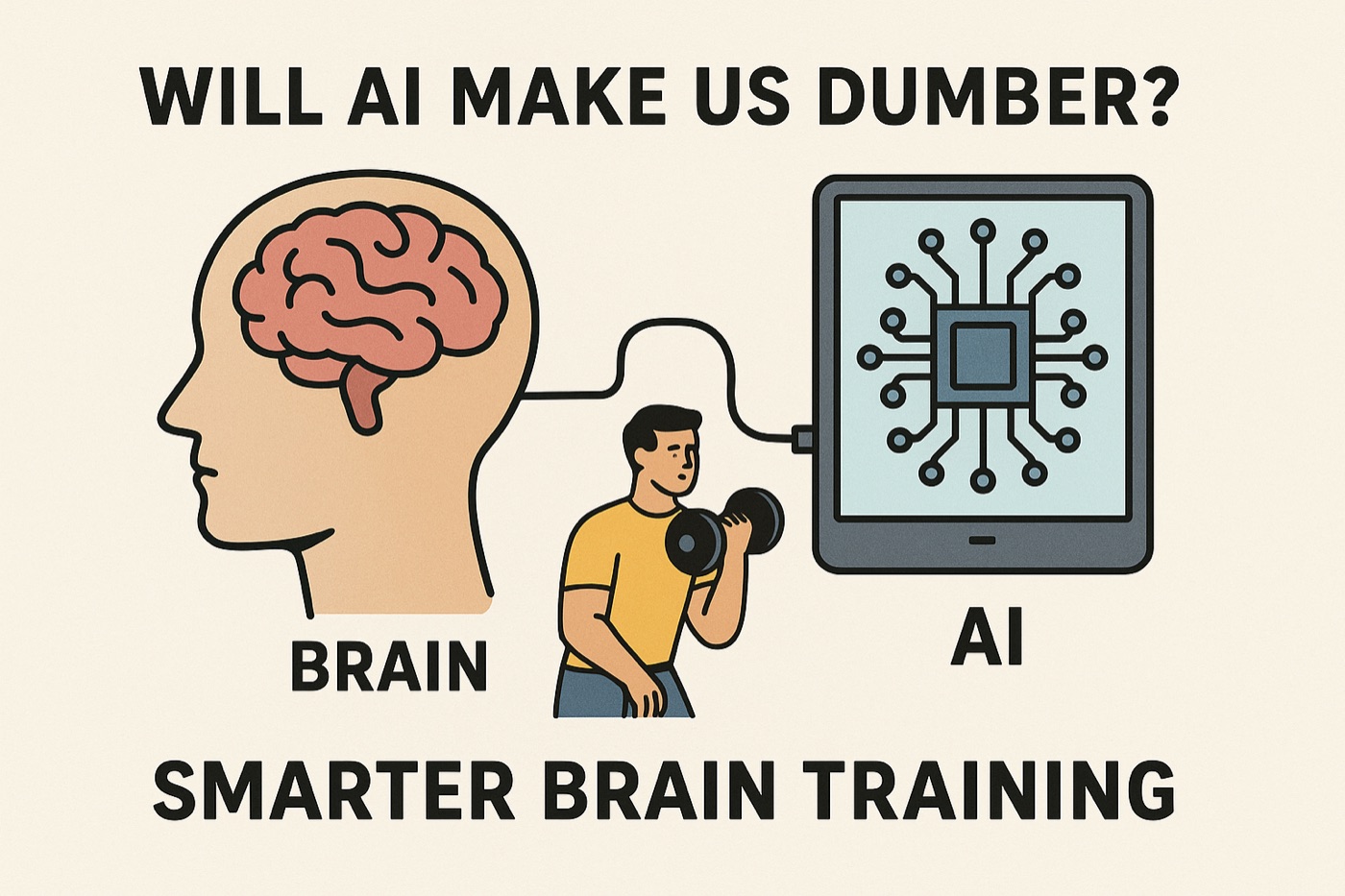
Recently, concerns have been raised that the mass adoption of artificial intelligence (AI) will make us mentally lazy and eventually lead to a decline in human intelligence. At first glance, this fear seems reasonable—for example, a recent experiment found that the brains of people writing with the help of AI showed weaker activity compared to those who wrote without any tools . This finding is part of a growing wave of research asking whether AI is making us “cognitively lazy” . In other words, if we delegate most mental tasks to smart machines, won’t our minds atrophy from lack of use?
My perspective is more optimistic: history shows that such fears emerge with every new technology, yet humanity has always managed to adapt. To illustrate, let’s draw a parallel with physical development after industrialization. Centuries ago, daily life was full of heavy physical labor. As machines gradually took over that work, many would have expected human bodies to weaken and health to decline. In reality, something else happened—a culture of targeted exercise emerged. Instead of relying on farming and manual labor to stay strong, we created gyms, sports clubs, and scientifically designed training methods. In short, I believe the same will happen with mental activity: rather than getting dumber, we’ll begin consciously training our brains—supported, but not replaced, by new technologies. Let’s look at why this analogy makes sense.
From Mechanization to Fitness: A Lesson in Adaptation
Over the past two centuries, humanity underwent a dramatic shift from manual labor to mechanization. Machines gradually took over most heavy physical work, inevitably reducing people’s daily activity levels . Populations moved from the fields to factories, and later to office desks. At the same time, technological progress brought an unprecedented leap in quality of life and medicine. The result? Average life expectancy, which for millennia hovered around 35–40 years, skyrocketed during the 20th century to roughly 80 years today . In other words, although we moved less, technology helped us live twice as long through better hygiene, medicine, and safety.
Of course, reduced activity had its dark side—the modern sedentary lifestyle has fueled epidemics of obesity and chronic diseases in many countries . But society didn’t sit idly by. By the late 19th century, a movement for physical culture had emerged: gymnastics clubs, organized sports, and in 1896, the revival of the Olympic Games—a symbol of a new era where exercise was pursued “for sport and health” rather than survival . Today, fitness centers, jogging trails, and swimming pools are everywhere.
More importantly, exercise turned out to be more effective and safer for health than old-fashioned farm labor. Physical work in the fields or on construction sites often lasted all day at low to moderate intensity—insufficient for real cardiovascular training . Heavy labor also meant awkward postures, chronic strain, and long-term wear on the body . In contrast, targeted workouts allow precise control—alternating intense effort with rest, using proper technique, and minimizing risk. For example, a 30-minute high-intensity interval workout challenges the cardiovascular system just enough, followed by recovery—producing improved endurance and lower resting blood pressure . In short, “smart” exercise brings more benefits than unstructured physical work, with far less risk of injury.
Thus, mechanization didn’t bring universal decline but transformation: physical fitness stopped being a byproduct of work and became a goal in itself. Today, anyone who chooses to can be healthier and stronger than their ancestors—thanks to deliberate, science-backed exercise. This is likely one factor behind rising life expectancy .
Whether or not people in the 19th century feared mechanization would ruin human bodies, we now know that society found solutions. Today, at the dawn of the AI era, a similar shift is happening—this time with mental work instead of physical.
AI and the Fear of Mental Laziness
For decades, our work and daily life increasingly demanded intellectual effort—calculations, writing, remembering, problem-solving. These very activities are now being transformed by AI. Models like ChatGPT can generate text, translate, summarize; other algorithms instantly provide information or solutions that once took humans hours. So the natural question arises: if AI does the “thinking” for us, won’t our brains weaken like unused muscles?
There is some scientific evidence backing this concern—or at least warning what can go wrong if we simply lean back. One concept is “cognitive offloading” —outsourcing tasks that the brain used to handle. In moderation, this can be positive: letting a computer do tedious calculations frees up mental energy for creativity. But if entire skills are constantly offloaded, they can atrophy. A Wall Street Journal journalist reported that after habitually using ChatGPT to write emails in a foreign language, he felt his own skills “rusting”—forgetting words, struggling to express himself . He wrote: “AI was eating my brain.” Psychologists warn: if you don’t use a skill—be it creativity or critical thinking—you gradually lose it .
Early studies echo this. A Microsoft and Carnegie Mellon University study found a weakening of critical thinking abilities among people who routinely trusted AI-generated answers without verifying them . Another study noted a troubling correlation between students heavily relying on ChatGPT for learning and worse performance, including memory decline and lower grades . Similarly, neuroscientist Louisa Dahmani showed in 2020 that people who fully rely on GPS have weaker spatial memories, since they no longer form “mental maps” of their surroundings . She summarized: “Tools like GPS and generative AI make us cognitively lazy… Most of us will take the path of least resistance” .
All of this paints a real danger: if we allow AI to replace effort entirely, we risk becoming less sharp, less attentive, and worse problem-solvers. But let’s return to our analogy with physical activity—because it also shows a way forward.
Targeted Workouts for the Brain: A New Era with AI
Just as the solution to physical passivity wasn’t to abandon machines but to add deliberate exercise to our lives, the solution to mental passivity may be similar. AI frees us from routine thinking—but that opens time and space for conscious brain training. Instead of accepting a future where “humanity gets dumber,” we can imagine one where people maintain and enhance their minds much as they now maintain their bodies at the gym.
In neuroscience, this idea is well-supported. The concept of “cognitive reserve” describes the brain’s ability to adapt and compensate, built up through lifelong learning and mental activity . People with greater cognitive reserve (from education, reading, problem-solving, social engagement) show fewer symptoms of age-related decline—for example, they develop dementia symptoms later, even if brain scans show physical changes . In other words, the brain strengthens with use—just like muscles.
Controlled studies confirm that cognitive training programs can measurably improve memory and attention in older adults compared to those who don’t practice . Even simpler activities—crosswords, Sudoku, learning a new language—are associated with sharper thinking. The principle is clear: “use it or lose it.”
Here’s where AI can help not as a crutch, but as a trainer:
- Personalized brain workouts: Apps like Lumosity, Elevate, and Neurobics already use AI to adapt task difficulty to the user’s performance. This ensures constant challenge at the right level—like a fitness coach adding weights when you’re ready .
- Scientifically validated training: Some platforms, like BrainHQ, developed by neuroscientists, have been tested in peer-reviewed studies showing measurable gains in memory, attention, and processing speed .
- AI as an intelligent teacher: AI tutors can notice knowledge gaps and pose tailored exercises rather than spoon-feeding answers. For example, some calculators (like QAMA) won’t show the final result unless you provide your own estimate first—forcing you to think . Similarly, AI chatbots could be designed to lead students through critical-thinking dialogues instead of just providing direct answers.
All of this points to a possibility: if we combine technology with conscious effort, we can achieve higher mental performance, not lower. Freed from rote tasks, we’ll have more capacity to focus on creativity, learning, and deliberate “mental fitness.”
Conclusion
In the end, whether AI makes us dumber or smarter depends on how we use it. Technology doesn’t dictate outcomes—we do. The history of mechanization shows that when one type of effort is automated, humans can respond by excelling in another. Today we have the same choice: to treat AI as a tool that frees time for growth, or as a substitute that atrophies our abilities.
As one analysis put it, technology can make us both “dumber” and “smarter”—the choice is ours . If we actively engage our minds, supported (not replaced) by AI, humanity will not decline. On the contrary—we may enter an era where our mental capacity is richer and more efficient than ever, just as our bodies today (with the right training) can be healthier and stronger than our ancestors’.
So instead of fearing “lazy brains,” let’s embrace smart brain training—backed by science and powered by technology. That’s a recipe not for decline, but for progress: AI plus human effort = a stronger brain, not the other way around.
Sources
- Study on brain activity when writing with AI assistance – reported in 2024 (ScienceDaily / Microsoft & CMU research).
- Historical increase in life expectancy – World Health Organization & global health data.
- Cardio benefits of structured exercise vs manual labor – American Heart Association, 2018.
- Dahmani, L. (2020). Research on GPS use and spatial memory. Massachusetts General Hospital.
- Cognitive reserve concept – Stern, Y. (2009). Cognitive reserve. Neuropsychologia, 47(10), 2015–2028.
- Randomized controlled trials on brain training and memory improvement – ACTIVE study and follow-ups.
- BrainHQ research – Posit Science, peer-reviewed publications on cognitive improvement.
- Reports on “cognitive offloading” and AI reliance – Wall Street Journal (2023), Microsoft/Carnegie Mellon study (2024).