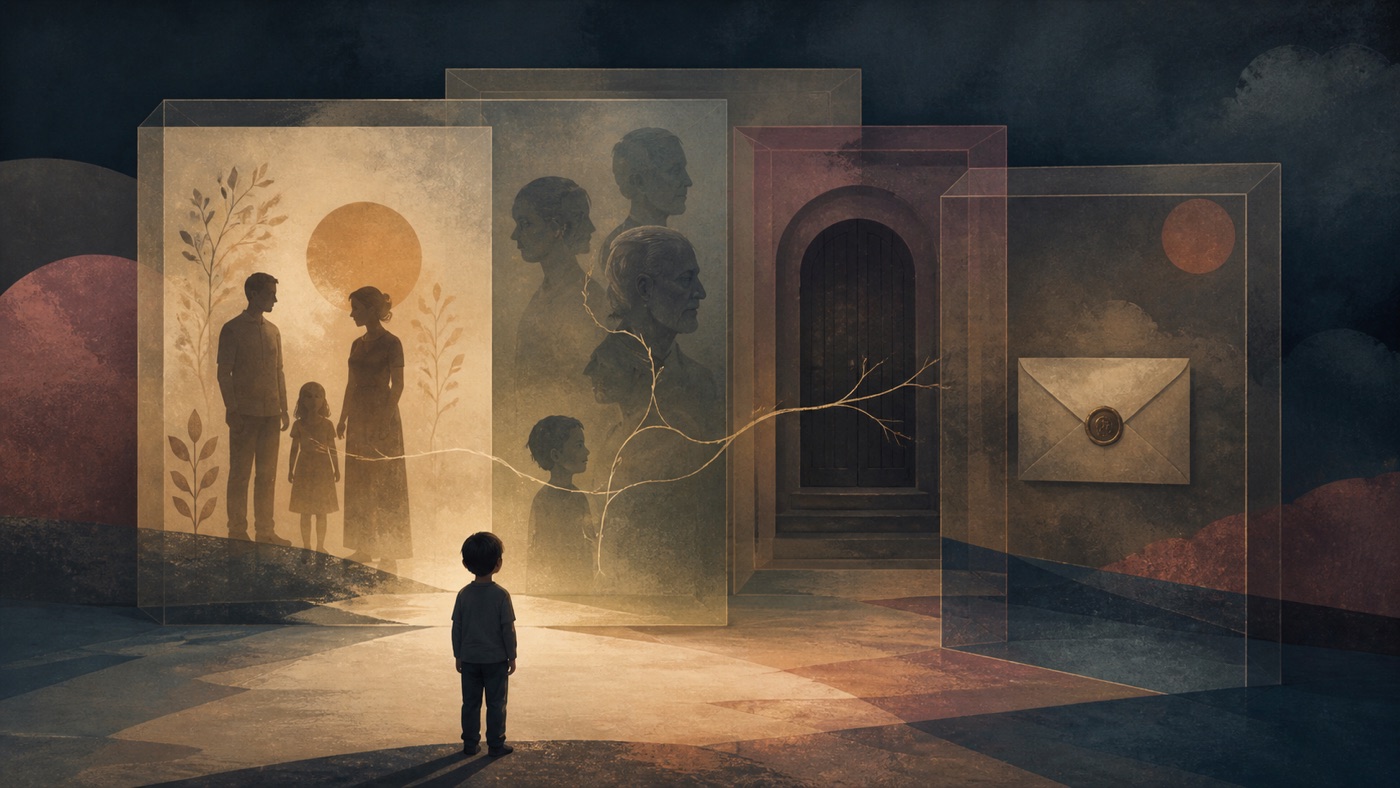
Primal fantasies are childhood fantasies that Freud describes as phylogenetic and inherited. They appear at different stages of psychosexual development and provide recurring schemas through which the child interprets questions of sexuality, origin and the relationship between the parents.
The concept emerged from an important change in Freud’s thinking about trauma, fantasy and the origins of neurosis.
From trauma to fantasy
Freud initially based his understanding of neurosis on the theory of trauma. He believed that neurotic manifestations were caused by sexual violence experienced in childhood. Such an event would produce an overwhelming amount of sexual tension in a child who did not yet possess the mechanisms needed to discharge it. The tension would remain blocked. If the superego had already begun to form, it would also support repression, because the means of satisfaction would be morally unacceptable.
Freud later began to doubt that every account reflected an actual act of abuse. Such cases appeared too frequently for him to accept that almost every girl in Vienna had been subjected to sexual violence. He therefore considered another possibility: a childhood fantasy could acquire the meaning and traumatic force of a real event.
This led him to the idea that the human psyche contains primordial, or primal, fantasies that are common to every child. One of the forms through which this idea developed was the fantasy of seduction.
An inherited psychic schema
Freud proposed that primal fantasies have a phylogenetic origin. In this view, they are inherited rather than acquired. They may once have corresponded to facts in human history and then have been transmitted across generations as psychic schemas that do not arise from personal experience.
At first, Freud tried to establish the reality of the scene in which a child witnesses sexual intercourse between the parents. Yet the fantasy seemed to exist before the event that awakened it and gave it a concrete form. The event did not necessarily create the schema; it could provide something to which an already existing schema became attached.
The main primal fantasies concern:
- The anatomical distinction between the sexes.
- The scene of seduction.
- The primal scene.
- The cloacal theory of birth.
They develop mainly at the beginning of the infantile genital, or phallic, phase.
The anatomical distinction between the sexes
These fantasies are organised around the child’s perception of the absence of a penis and the questions that follow from the apparent absence of the male sexual organ. They are also connected with penis envy and with the child’s attempts to explain anatomical difference.
The fantasy of seduction
In the fantasy of seduction, the child imagines being subjected to sexual abuse. Freud links this fantasy to a strong but unexplained attraction toward a forbidden object. The child cannot accept the longing as its own, so the wish is projected outward. The fantasy then presents the external object as wanting what the child itself longs for.
The primal scene
The primal scene is the fantasy of a sexual encounter between the parents. The child interprets intercourse as an act of aggression by the father against the mother. The scene produces sexual arousal while also awakening a fear of castration, connected with the parents’ genitals and the anatomical difference between them.
The cloacal theory
The cloacal theory consists of fantasies about the origin of children. The child imagines that babies are born through the anus. The mother eats something, and the father is the one who gives it to her.
This explanation protects the child from anxiety about sexuality because it removes the sexual act from the origin of children. The visible changes in the mother’s body cannot exclude the father entirely, but intercourse and the genitals are connected with the castration complex and are therefore avoided. The imagined act may also remain connected with the primal scene and with the idea of violence by the father against the mother.
Enigmatic messages and the child’s own investigation
Laplanche takes the universality of these fantasies and their independence from culture as support for their inherited nature. At the same time, primal fantasies may also be awakened by what he calls enigmatic messages from adults.
A child may be told, for example, that it was brought home from the hospital. Other stories, such as the explanation that babies are delivered by a stork, may create distrust toward adults. This distrust can produce a sense of alienation and encourage the child to begin an independent investigation into its own origin.
What remains after repression
According to Freud, these fantasies are repressed during childhood and are therefore not remembered by adults. Their consequences, however, continue to influence adult life and may sometimes appear through symptoms.
The fantasy of violence by the father can shape a later attitude toward sexuality. Being told that one was brought from the hospital can contribute to a feeling of alienation. Psychoanalytic literature also describes a related fantasy: the belief that one is adopted.
In my observation, the adoption fantasy appears at the beginning of the genital phase, around the onset of puberty. At that point, it seems to express the young person’s wish to distinguish and separate themselves from their parents. I therefore think that this fantasy has a more specific cultural origin and should not necessarily be considered a primal fantasy. Another possibility is that different fantasies contain different degrees of phylogenetic determination, and that the inherited element in this one is weaker.
A theory constructed retrospectively
Because primal fantasies are repressed, they can be observed and evaluated only through psychoanalysis. Our understanding of them is therefore constructed retrospectively.
This creates an important difficulty. Were these truly early childhood fantasies, or are they present constructions needed to explain later phenomena? More precisely, are they representations to which latent libido can be bound, put into words and discharged, so that it is no longer experienced as an unformed anxiety?
The concept of primal fantasies remains an attempt to explain why certain scenes and questions appear with such persistence in psychic life: not simply as memories of individual experience, but as inherited schemas that later events can awaken and fill with personal meaning.